NostalGame: Quake III Arena and the Rise of Competitive PC Shooters
Released in December 1999, Quake III Arena stripped away the single-player campaign and bet everything on multiplayer, arriving the same week as Unreal Tournament. This NostalGame looks at how id Software's arena shooter played, why it became a competitive standard, and what its legacy says about the PC shooter.
 admin
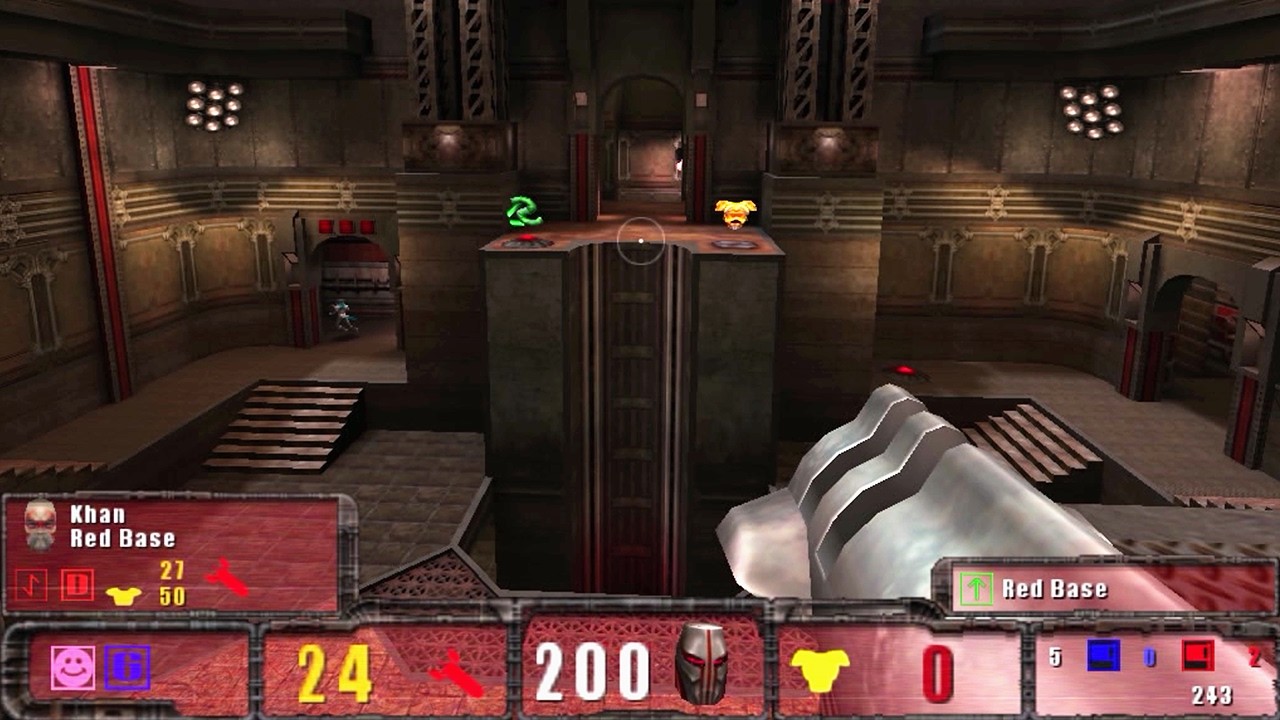
In December 1999, id Software released a first-person shooter with no real story to speak of. Quake III Arena arrived on 2 December 1999, and Epic Games' Unreal Tournament reached Europe a day later, on 3 December, setting up a head-to-head contest for the same online shooter audience at the moment internet play was expanding rapidly ¹. That timing is part of the story: two studios, two visions of what a competitive shooter should be, and a community that had to choose.
What Quake III Arena chose to be was narrow on purpose. After Wolfenstein and Doom had established the first-person shooter and two Quake games had built on that foundation, id Software dropped the traditional story campaign and pointed the whole game at multiplayer. The single-player mode existed, but it meant fighting bots rather than following a narrative. For players raised on Doom's corridors and Quake's gloomy gothic maps, that was a statement: the arena itself was the product.
The arenas were not realistic places. They hovered in space, connected by bounce pads, and the weapons were deliberately outlandish. That description comes from someone who played the demo and was initially alarmed by it: Eurogamer's Rupert Loman recalled being worried by the bounce pads, a laggy lightning gun, messed-up air control and levels floating in space, before concluding that id knew what it was doing all along ². His verdict, published in Eurogamer's 2009 lifetime top ten, was that Quake III Arena is the best multiplayer experience ever created. That is a fan's judgment, not a measurement, but it captures how the game landed with the people who committed to it.
The commitment was real. Jim Rossignol, writing in The Escapist in 2006, described being fired from a finance job because his attention was elsewhere: he had a Quake team to run. He credited years of patching and layer upon layer of mod coding with turning a basic idea — people running around arenas blasting each other — into a competitive experience he said had yet to be paralleled ³. Read that as period testimony rather than an objective ranking. Still, it tells you something about the game's gravity: Quake III was not just played, it organized lives.
Part of that pull came from how the game rewarded mastery. The weapons were not balanced toward casual use; they were balanced toward players who learned spawn timings, map control and movement quirks. Eurogamer's Tom Bramwell traced the birth of the true "twitch" shooter to the railgun, arguing that it — along with Counter-Strike's AWP — was part of why some players struggled to adjust to twin-stick console controls later on. Whether or not one accepts that lineage, the observation points at something real: Quake III demanded precision aiming and fast decisions in a way that earlier deathmatch games had only hinted at.
The mod scene mattered as much as the base game. Rossignol's account emphasizes community coding layered on top of id's foundation, and that pattern was familiar from the Quake era: players did not just consume the game, they rebuilt it. This is where the article must be careful. The sources here establish that modding and patching shaped Quake III's competitive form, but they do not give a detailed inventory of specific mods, leagues or tournament results, and this piece will not invent them. What can be said is that the game's competitive identity was co-authored by its players over time.
The rivalry with Unreal Tournament sharpened both games. Vandal's retrospective notes that the two titles competed for the same community and that Unreal Tournament, originally planned as an expansion to Unreal, grew into a standalone series with free expansions and later console ports to PS2 and Dreamcast. Quake III's answer was purity: fewer distractions, tighter arenas, a game built to be played against other people. Neither approach was obviously correct, and the argument between them never really ended — it just moved to different games.
Quake III's legacy is easiest to see in what came after. The arena shooter as a genre, the idea of a shooter whose single-player mode is essentially training for multiplayer, and the expectation that a competitive game will be patched and modded into its final form all trace back to this period. The Escapist piece, written in 2006, already treated Quake III as a benchmark against which newer competitive games were measured. Eurogamer's 2009 list placed it among the ten best games of the outlet's lifetime, with one contributor noting he had competed against two world number ones, Thresh and Fatal1ty, and lost both. Anecdotes like that are not data, but they show the game sitting at the center of a professional scene that was still small enough for a magazine editor to enter.
It is worth being clear about what this retrospective cannot claim. The sources do not establish player counts, sales figures, tournament prize pools or a precise timeline of patches, and no numbers of that kind appear here. Nor does this article describe hands-on play; the impressions above belong to the people who wrote them in 2006 and 2009, and they are presented as such. What the record does support is a straightforward conclusion: Quake III Arena took the deathmatch idea and refined it into a competitive discipline, arrived at the right moment for online play to spread, and left behind a template that shooters are still arguing with.
For readers who came up through the hardware of that era, the game belongs to the same moment as the mice and controllers people bought to play it. The Microsoft IntelliMouse and the Logitech WingMan were part of the same desktop ecosystem, and the optical mouse in particular became the default tool for the twitch aiming Quake III rewarded. The game did not create that hardware wave, but it gave players a reason to care about it.
Twenty-five years on, the arenas still read as a design argument: that a shooter can be a sport first and a story second. Unreal Tournament made the opposite case with more content and more spectacle, and both games are remembered. Quake III's particular legacy is the purity of the bet — no campaign to hide behind, no narrative to soften the loss, just a map, a railgun and another player.
Sources
- ¹ Quake 3 y Unreal Tournament han cumplido 20 años - Quake 3 y Unreal Tournament han cumplido 20 años vandal.elespanol.com
- ² Page 2 | Eurogamer's Lifetime Top 10 - Eurogamer's Lifetime Top 10 www.eurogamer.net
- ³ Deathmatch-making - Deathmatch-making www.escapistmagazine.com