
NostalTech: The Commodore Amiga 500 and the Home Computer Multimedia Era
The Commodore Amiga 500 arrived in 1987 and became Europe's defining home computer, pairing 4096-colour graphics and four-channel stereo sound with a price young buyers could reach. This NostalTech look back at what the machine was, why it mattered, and what it taught us about accessible creative tools.
 admin
In July 1985, Commodore rented the Lincoln Center in New York and put Andy Warhol on stage to paint Deborah Harry with a mouse. The machine under his hand was the Amiga, and the pitch was simple: colour graphics and sound that the Mac and the IBM PC could not match ¹. The show mattered because it announced a new idea — that a personal computer could be a medium for images and music, not just a spreadsheet terminal.
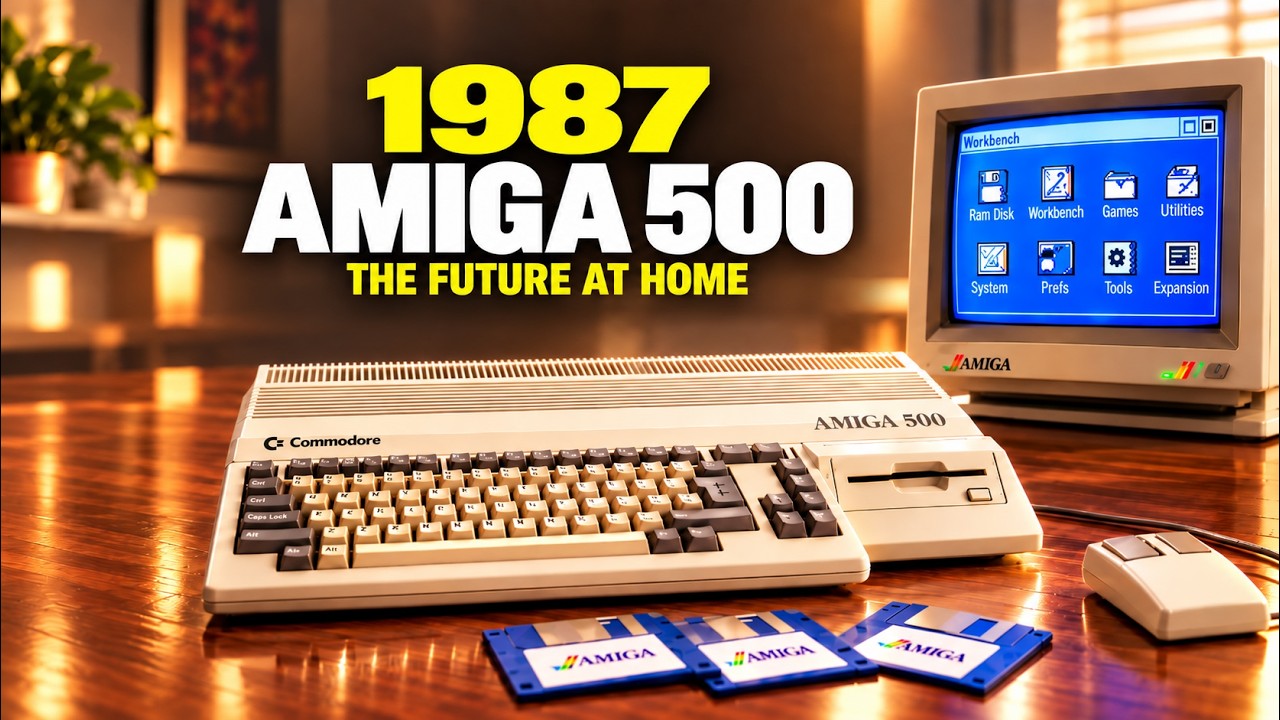
The computer that actually carried that idea into homes arrived two years later. The Amiga 500, released in 1987, was the cheap model in the family, and in Europe it became the machine people actually bought. It displaced the 8-bit generation, outflanked the Atari ST and the IBM PC with younger buyers, and by around 1990 dominated the home and gaming market in countries such as Britain and Germany ². That is the strange shape of the Amiga story: the ambitious 1985 launch made the name, but the modest 1987 box made the era.
What made the A500 different was not raw clock speed but the custom chips that handled graphics and sound alongside the main processor. Commodore's launch machine could display 4096 colours, and it carried four-channel stereo sound — a combination that made it a natural fit for visual and musical work at a time when those jobs normally required dedicated studio or video equipment. The A500 inherited that architecture at a fraction of the price.
The regional split is part of the story. The A500 lacked a built-in TV connection, which in the United States pushed buyers toward an adapter or a dedicated monitor. In Britain and Germany this barely registered: European televisions already had a Scart input, and the Amiga could feed it a sharp RGB picture straight out of the box. Adding another 512 kilobytes to reach a full megabyte turned the machine into what one contemporary assessment called an unmatched, future-proof multimedia system for comparatively little money. A whole continent got the Amiga's best picture through a connector its American sibling had to work around.
The software followed. From 1988 onward the installed base pulled in a wave of high-quality titles, even as American companies began drifting away from Commodore. The machine's graphics and sound gave developers room to be ambitious, and the games that resulted are the reason the platform is remembered with affection rather than just nostalgia for a logo.
Music is where the A500's afterlife is clearest. In the early 1990s, producers used Amigas to build the hardcore, jungle and drum'n'bass records that shaped British dance music, and the machine's limitations became part of its sound. The Guardian's account of that period describes the Amiga as the "poor man's studio" — a phrase that captures exactly why the machine mattered. Before it, making electronic music meant paying for a studio. After it, a teenager with a home computer and a sampler could build tracks in a bedroom. Jungle producer Gavin King, known as Aphrodite, kept an Amiga 1200 in his studio for decades and described its bass as constant in volume and able to push a pressing to the limit ³. The 512 kilobytes of memory in the original A500 is a rounding error against a modern phone, and that gap is precisely the point: the constraint forced invention rather than imitation.
That is the lesson worth carrying forward. The Amiga 500 was not powerful. It was unusually well designed for creative work at a price ordinary households could justify, and it arrived at the moment when that combination could reach a mass audience. The same pattern repeats today whenever a cheap tool — a free local AI runner, a hobbyist 3D printer, a second-hand GPU — puts a capability that once belonged to professionals into a bedroom. The technology changes; the mechanism does not. Accessible tools do not just democratise existing work, they create forms nobody had a reason to attempt before.
There is also a cautionary note. Commodore's machine was ahead of its rivals technically and still lost its way commercially, a reminder that a superior architecture is not a business plan. The A500's success was brief, and the platform's decline came faster than its rise. What survived was the culture it enabled: the demos, the music, the games, and the assumption that a home computer is a place to make things.
For a modern reader, the Amiga 500 is less a museum piece than a case study in what makes a computing platform matter. It was not the fastest machine of its generation, and it was not the most expandable. It was the one that put colour, sound and a mouse in front of people who could afford them — and then got out of the way.
Sources
- ¹ Amiga 500: Der Kultcomputer der Neunziger wird 30 - Amiga 500: Der Kultcomputer der Neunziger wird 30 www.diepresse.com
- ² Amiga 500: Der Kultcomputer www.chip.de
- ³ ‘It was the poor man’s studio’: how Amiga computers reprogrammed modern music - ‘It was the poor man’s studio’: how Amiga computers reprogrammed modern music www.theguardian.com