NVIDIA RTX Spark Puts Unified Memory and Local AI at the Center of the Windows Laptop
NVIDIA's RTX Spark platform pairs an Arm-based Grace CPU with Blackwell graphics and up to 128GB of unified memory, with laptops from six major vendors starting at $2,599. The pitch blends local AI agents, content creation and gaming, but the headline performance numbers come from NVIDIA itself rather than independent testing. Here is what the sources actually establish, and what remains open.
 admin
admin
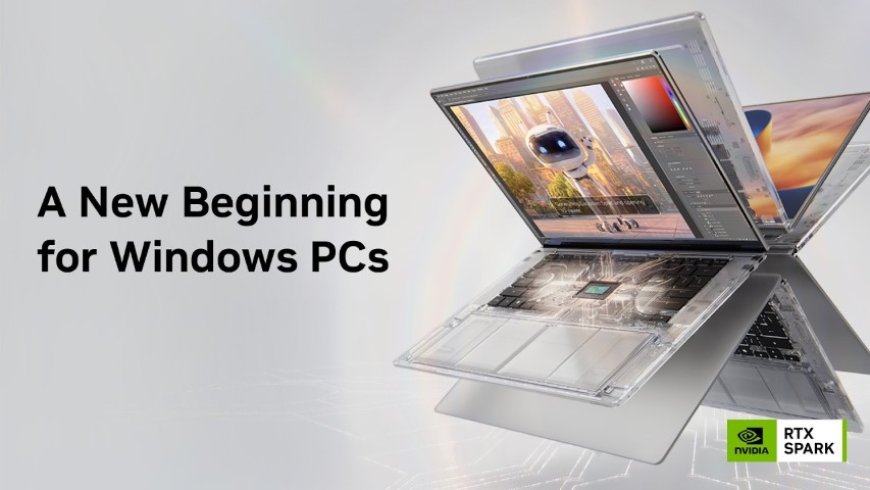
NVIDIA is extending its RTX branding from add-in graphics cards into the core of the Windows laptop. The RTX Spark platform combines an Arm-based Grace CPU, Blackwell graphics and up to 128GB of unified memory, according to Digit's reporting on the launch [S1]. That report puts the CPU side at up to 20 Grace cores [S1], while NVIDIA's own announcement describes the chip as delivering up to 1 petaflop of FP4 AI performance [S2].
Availability is staggered. RTX Spark laptops from ASUS, Dell, HP, Lenovo, Microsoft and MSI start at $2,599 and went on sale on 16 October [S1], a date NVIDIA's press release also treats as the on-sale date for systems from the same six vendors [S2]. Compact desktops are scheduled to follow in November, with Acer, ASUS, Dell, Gigabyte, HP, Lenovo and MSI named as partners [S1]. Pricing for the desktops is not established in the supplied material, and Indian pricing has not been announced; Digit's suggestion of roughly Rs 3,00,000 is the outlet's own approximation rather than an official figure [S1].
The architectural story is the memory. In a conventional gaming laptop, the GPU has a fixed pool of dedicated video memory separate from system RAM, and that capacity ceiling shapes what fits: model weights, scene assets, texture budgets. RTX Spark instead gives the CPU and GPU access to one large pool of up to 128GB [S1]. That is a meaningful departure from the pattern that has defined the GeForce line for most of its history, where each generation has been marketed largely on raw speed and on how much dedicated memory shipped on the board. Whether the unified design translates into sustained real-world advantage is a separate question, and one the sources do not answer.
NVIDIA's claims are ambitious. The company says RTX Spark lets developers, creators and gamers run frontier AI models locally, render 3D scenes larger than 90GB and play AAA titles at 1440p above 100 frames per second on a slim portable device [S2]. These are vendor figures from a vendor press release, not independent benchmarks, and the supplied sources contain no third-party testing [S2]. Frame rates in particular depend on the game, settings, resolution and upscaling; thermals, fan noise, battery life and sustained performance under load are not established in either source and should be treated as unknown until measured.
Software support is pitched as day one. NVIDIA lists Adobe Photoshop and Premiere, the Hermes and OpenClaw agents, and games including Gears of War: E-Day and NBA 2K27 with DLSS 5 as launch-ready workloads [S2]. Digit's account adds NVIDIA Broadcast, DLSS 5 updates and an RTX Remix mod kit aimed at Minecraft Java, alongside path-traced Minecraft as a demonstration of what the hardware can do [S1]. Neither source explains what DLSS 5 changes technically, how the Minecraft mod kit works, or what the local agent frameworks require in practice, so those details remain unknown here.
There is a hardware-culture angle worth noting, as interpretation rather than reported fact. GeForce began as a discrete graphics brand and grew into a product family defined by ever-larger chips, ever-faster memory and, more recently, dedicated AI acceleration and ray tracing. RTX Spark moves the same silicon vocabulary, RTX graphics, CUDA and the AI stack, into a system-on-chip design for thin laptops [S2]. That reframing matters for buyers: the comparison set shifts from a gaming laptop with a discrete GPU to something closer to a compact AI workstation that also plays games.
The open question is software maturity. An Arm-based CPU running Windows raises compatibility considerations for applications and games built around x86 assumptions. The sources name supported apps and titles but do not describe how broadly the ecosystem is covered, so the practical scope of compatibility is not established [S1][S2]. It is also unclear how much of the 128GB pool can be committed to graphics at any given moment, and whether the memory behaves identically for CPU and GPU workloads, questions the supplied excerpts leave unanswered.
For now, the launch is best read as a direction of travel: NVIDIA pushing unified memory, local model inference and RTX software features into the laptop chassis rather than treating them as desktop or data-center concerns [S1][S2]. The claims are large and the price of entry is high. Independent benchmarks, thermal measurements and real-world reports on Arm compatibility will decide whether RTX Spark is a new class of PC or a well-specified niche.
Sources
- [S1] From running local agents to playing Minecraft with path tracing: NVIDIA maps out life with RTX Spark (published: 2026-10-14T16:00:00Z; source id: src_32741bc213ead6e78cea26a2)
- [S2] NVIDIA RTX Spark PCs Available Today — A New Beginning for Windows PCs (published: 2026-10-15T16:00:00Z; source id: src_4597113913cc451317ea3217)